
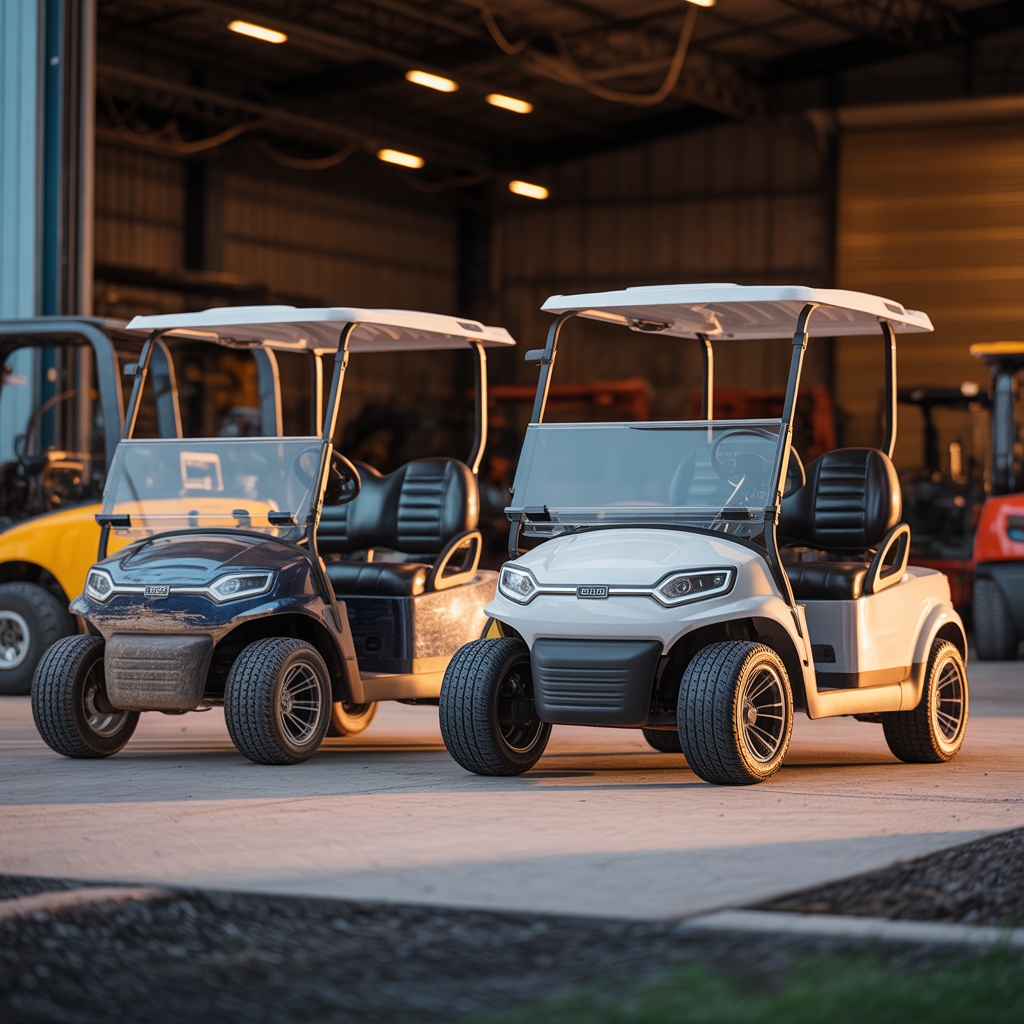
Choosing quality equipment pays off — literally. A high-quality lithium battery system alone can save between $1,400 and $3,100 over ten years, and premium models hold their resale value far better than budget alternatives, which depreciate rapidly.
The hidden costs of "budget" options tell the other side of the story. Cheap imports frequently suffer from poor traction on low-grade tires, rusted steel frames, and "unicorn parts" that are nearly impossible to source when something breaks — turning a low upfront price into a long-term money pit. Lead-acid battery alternatives compound the problem, requiring frequent replacements and costly maintenance that erode any initial savings.
While golf cars are the example here, the same principle applies across industries: quality engineering isn't a premium — it's the more economical investment.
The High Cost of Buying Cheap: Why Your "Bargain" Golf Cart is a Money Pit in Disguise
In the world of Low-Speed Vehicles (LSVs) and golf cars, the sticker price is a siren song. It beckons you with the promise of wind-in-your-hair freedom, neighborhood cruising, and easy transportation—all for a price that seems too good to be true. You scroll through listings of shiny, aggressive-looking carts from brands you’ve never heard of, often boasting features that would cost thousands more on a Club Car, E-Z-GO, or Yamaha. They look the part. They have the lifted suspension, the knobby tires, the massive touchscreens, and the LED underglow. And they are thousands of dollars cheaper than the competition.
It feels like a hack. It feels like you are beating the system. But as thousands of buyers discover every year, the "system" usually wins in the end.
In the golf cart industry, price is rarely just a reflection of brand prestige; it reflects engineering, materials, and strictly audited supply chains. When you buy a cheap import or a "budget" cart, you aren’t just paying less upfront; you are signing up for a subscription service of headaches, replacement parts, and downtime that will eventually eclipse the cost of the premium vehicle you skipped.
Let’s break down the true cost of ownership, looking beyond the brochure and into the mechanics, the rubber, and the batteries that power your ride.
The Heart of the Problem: Lithium vs. Lead-Acid
The most critical component of any electric LSV is the battery system. It determines your range, your acceleration, your maintenance schedule, and ultimately, the lifespan of the vehicle.
Recently, industry expert Chandler Hall from Eco Battery shared a breakdown on LinkedIn that perfectly illustrates the "penny-wise, pound-foolish" nature of battery choices. While his comparison focused on the upgrade from lead-acid to lithium, the logic applies directly to the choice between a cheap cart with outdated tech and a quality cart with a modern power plant.
The Upfront Illusion
As Hall notes, the upfront price doesn’t tell the whole story. Total Cost of Ownership (TCO) is the only metric that matters.
- Cheap/Standard Tech (Lead-Acid): The upfront cost for a lead-acid pack is roughly $900–$1,500.
- Quality Tech (Lithium): A premium lithium pack (like the 51V 105AH Eco Battery) runs $2,500–$3,500.
On day one, the lead-acid option seems like the winner. You save $2,000 instantly. But this is where the math starts to turn against you.
The 10-Year Reality
Lead-acid batteries are heavy, inefficient, and fragile. They require regular watering—a messy chore that, if neglected even once, can ruin the pack. Even with perfect maintenance, a lead-acid set typically lasts 3 to 5 years. Over a 10-year period, you aren’t buying one set of batteries; you are buying two or three.
- Replacement Costs: Three sets of lead-acid batteries over a decade will cost you $2,700–$4,500 in replacement hardware alone.
- Maintenance: Lead-acid batteries corrode cables and terminals. They require distilled water. Hall estimates these maintenance costs at $300–$600 over ten years.
- Energy Waste: Lead-acid chargers are less efficient, turning more of your electricity into heat rather than range.
Contrast this with a high-quality lithium system. A premium lithium pack is designed to last the full 10-year term. It requires zero maintenance. There is no watering, no acid corrosion, and no terminal scrubbing.
The Final Tally (per Hall’s data):
- Lithium 10-Year Cost: $2,500–$3,500.
- Lead-Acid 10-Year Cost: $3,900–$6,600.
The "expensive" option actually saves you anywhere from $1,400 to $3,100. And this doesn't even account for the performance benefits. A lithium cart is hundreds of pounds lighter, meaning better braking, zippier acceleration, and less wear and tear on your suspension and tires.
The "Cheap Lithium" Trap
A growing issue in the import market is the "Cheap Lithium" cart. These vehicles claim to have lithium batteries, but they use low-grade cells without a sophisticated Battery Management System (BMS). When these proprietary packs fail—and they do—you cannot simply swap them out for a standard unit because the cart’s computer is often locked to that specific, unavailable battery. You end up with a 2,000-pound paperweight because you can’t source a replacement BMS for a battery made in a factory that no longer exists.
Where the Rubber Meets the Road: Tires and Safety
If the battery is the heart, the tires are the shoes. And you wouldn’t run a marathon in flip-flops.
Cheap carts almost universally come equipped with cheap tires. To the untrained eye, a tire is a tire—it’s black, round, and holds air. But the differences in construction between a budget "bias-ply" tire and a premium "radial" tire are night and day.
Bias-Ply vs. Radial
Budget imports use bias-ply tires because they are cheaper to manufacture. These tires have stiff sidewalls and a rounded profile.
- The Ride: They transmit every bump, crack, and pebble directly into your spine. If you leave the cart parked for a week, they develop "flat spots," causing the cart to thump-thump-thump for the first mile until they warm up.
- The Wear: They wear out unevenly and quickly. You might get two years out of a set before the tread is gone or the sidewalls crack.
Premium LSVs come with automotive-grade radial tires. These have flexible sidewalls that absorb road impact, providing a smooth, car-like ride. They don't flat-spot, and they typically last twice as long as their bias-ply counterparts.
The Safety Gap
The most alarming difference is traction. Cheap tires often use hard, plastic-like rubber compounds to extend their life artificially. In dry conditions, they are mediocre. In wet conditions—like a Florida afternoon shower or a dewy morning on the golf course—they are dangerous. Stopping distances increase significantly, and the risk of sliding during a turn is real. When you are carrying your family or grandkids, saving $200 on a set of tires stops feeling like a victory.
The "Unicorn Part" Problem: Service and Support
This is the single biggest nightmare for owners of cheap imported carts.
When you buy a Club Car, E-Z-GO, or Yamaha, you are buying into an ecosystem. There are thousands of dealers across the country. There are warehouses stocked with brake pads, solenoids, controllers, and axles. If a part breaks in 2030, you will likely be able to find it.
When you buy a "Brand X" cart from a pop-up dealer or an online drop-shipper, you are on your own.
The Model Year Myth
Established manufacturers have "model years." If you have a 2022 model, the parts are standardized. Cheap import manufacturers work in batches. The brake calipers used on the "Model Z" cart in January might be different from the ones used in March because the factory switched suppliers to save 50 cents per unit. When you need new brake pads two years later, you might find that no one stocks them. You aren't just looking for a part; you're looking for a unicorn.
The "Mechanic Mike" Reality
Go to any reputable golf cart service center and ask them if they work on [Insert Obscure Internet Brand Here]. The answer is almost always a polite but firm "No." Mechanics refuse to touch these carts for two reasons:
- Liability: The build quality is often so poor that fixing one thing leads to another breaking, and the customer blames the mechanic.
- Parts Unavailability: They don't want a cart stuck in their service bay for six weeks while they scour the internet for a voltage regulator that may or may not exist.
Buying a cheap cart often means becoming your own mechanic, fabricating your own parts, and scouring forums for help from other stranded owners.
Frame and Chassis: Rust Never Sleeps
The backbone of your cart is the frame.
- Premium Standard: Brands like Club Car use aircraft-grade aluminum frames. They are light, strong, and crucially, rust-proof. If you live in a coastal area like Florida, the Carolinas, or California, this is non-negotiable. Salt air eats steel for breakfast.
- Cheap Import: These almost exclusively use welded steel frames. While they may be powder-coated, the coating is often thin or applied over poorly prepped metal.
Within a year or two, you will see the tell-tale orange bleed of rust at the weld points. Inside the battery tray (especially if you are using lead-acid batteries that give off-gas acid), the rot accelerates. Five years in, you might have structural integrity issues. A rusted frame kills the resale value of the vehicle instantly.
Furthermore, the suspension components on cheap carts utilize low-quality rubber bushings. These degrade quickly, leading to the infamous "squeak and rattle" symphony. You hit a bump, and the cart sounds like a bucket of bolts. Replacing these bushings is a labor-intensive job, assuming—again—that you can find the replacements.
The Charging Reality: Range Anxiety and Efficiency
Chandler Hall’s LinkedIn post touched on efficiency, but it’s worth expanding on the user experience of charging.
Cheap carts often use "dumb" chargers. They blast energy into the batteries without sophisticated monitoring. This leads to:
- Overheating: Both the charger and the batteries get hotter than necessary, degrading their life.
- Inaccuracy: The charger might say "100%," but the pack is not balanced, meaning one cell is full and another is at 80%. As soon as you drive, the weak cell triggers a shutdown, and your "30-mile range" becomes 5 miles.
- Electricity Costs: Inefficient charging draws more power from your wall. Over 10 years, the difference in electricity capability between a smart lithium charger and a cheap lead-acid transformer can be hundreds of dollars.
Premium carts, especially those with integrated lithium systems, talk to the charger. They balance the cells perfectly every time. They stop drawing power when full. They provide true "Gas and Go" reliability. You never have to worry if your cart will make it to the clubhouse and back.
Resale Value: The Exit Strategy
Eventually, you will want to sell your cart. This is the final financial reckoning.
The Premium Cart: A 5-year-old Club Car or E-Z-GO is a liquid asset. There is a massive market for used carts because buyers know they can be refurbished, parts are available, and the frames are solid. These carts depreciate, but they hit a floor and hold steady. You can often sell a well-maintained premium cart for 50-60% of what you paid for it.
The Cheap Import: The resale market for off-brand imports is brutal. Dealers won't take them as trade-ins because they can't warranty them to the next buyer. Private buyers are wary because they’ve read the horror stories online. You often see listings for these carts languishing for months, with price cuts every week. Eventually, they are sold for pennies on the dollar, or worse, they are scrapped because the cost of a necessary repair (like a controller or battery pack) exceeds the value of the vehicle.
As the saying goes in the industry: "You can pay for a premium cart when you buy it, or you can pay for it when you sell it." With a cheap cart, you pay when you buy it (in repairs), and you pay when you sell it (in depreciation).
Conclusion: The "Buy Nice or Buy Twice" Philosophy
There is a place for budget products in this world. If you need a disposable tool for a one-time job, buy the cheap one. But a golf cart or LSV is not a disposable tool. It is a vehicle you trust to transport your family, your friends, and yourself. It is a vehicle you expect to be ready when you turn the key.
The data is clear. Whether you look at the 10-year battery costs provided by Eco Battery ($3,100 in savings with Lithium), the safety of tires, or the availability of parts, the "bargain" cart is a myth.
When you factor in the frequent battery replacements, the worn-out tires, the rusted frames, the frustration of downtime, and the abysmal resale value, the cheap cart is actually the most expensive vehicle you can buy.
Do yourself a favor: Look at the 10-year timeline. Invest in quality engineering, a reputable dealer network, and a proven battery system. Your wallet—and your sanity—will thank you down the road.
Comments (0)
Leave a Comment
No comments yet. Be the first to comment!